
Why Polyurethane’s Future Depends on Systems, Not Just Materials
The global conversation on polyurethane is changing quickly.
Across Asia, Europe and Australia, we are seeing rapid advances in lowercarbon inputs, CO₂-based polyols, and breakthrough chemistry that reimagines waste carbon as a valuable feedstock. The commissioning of the world’s first 80,000ton CO₂-based polyol facility, utilising technology developed by Econic Technologies Ltd, marks a significant milestone for the global polyurethane industry.
These innovations matter. But they are only part of the story.
Circularity doesn’t succeed at the point of production; it succeeds or fails at end-of-life.
Innovation Is Moving. Recovery Is Not.
From flexible foam used in bedding and furniture to automotive and consumer applications, polyurethane sits at the centre of modern product design. It delivers comfort, durability, and performance at scale, increasingly with lower carbon credentials.
In Australia and globally, we continue to see a gap.
While material innovation accelerates, recovery systems lag. We often do not know whether circularity has worked until a product reaches the end of its first life. That is where theory meets reality.
In Australia’s mattress sector, this reality can no longer be ignored.
Each year, approximately 1.8 million mattresses reach end-of-life. Flexible polyurethane foam is found in almost every mattress sold in Australia. Foam can be separated and bailed, but resource recovery only works if the system around it works.
Foam Sits at the Centre And So Do the Challenges
Flexible polyurethane foam is both the solution and the problem.
Its low density and high volume enable efficient transport of new products across vast distances, particularly in a country as large and dispersed as Australia. The “bed in a box” mattress exists because of foam.
Come end-of-life, those same characteristics become barriers.
Foam is expensive to transport, difficult to store, and sensitive to logistics costs. In recovery systems, transport, not processing, is often the dominant cost, especially for regional and remote areas.
This is why improving material chemistry alone will never be enough.
Circularity Is a System Outcome
At the Australian Bedding Stewardship Council (ABSC), we work across the system – from design to recovery – coordinating foam producers, manufacturers, retailers, recyclers, and government.
What we have learned is simple, but critical:
- Better materials are necessary but alone don’t solve the problem.
- Systems must align across design, recovery, and end markets.
- Without demand, there is no scale.
- Without scale, there is no system.
Foam can be recovered effectively. When end markets are missing, the material does not move and circularity stalls.
This challenge is not unique to Australia.
Globally, we see different policy settings: regulated systems in Europe, voluntary schemes in Australia, fragmented approaches in the United States. Yet the underlying constraint stays the same: How do we connect production with recovery at scale?
Why Global Collaboration Matters
Materials, products, and supply chains are already global. Recovery systems, however, are still largely local.
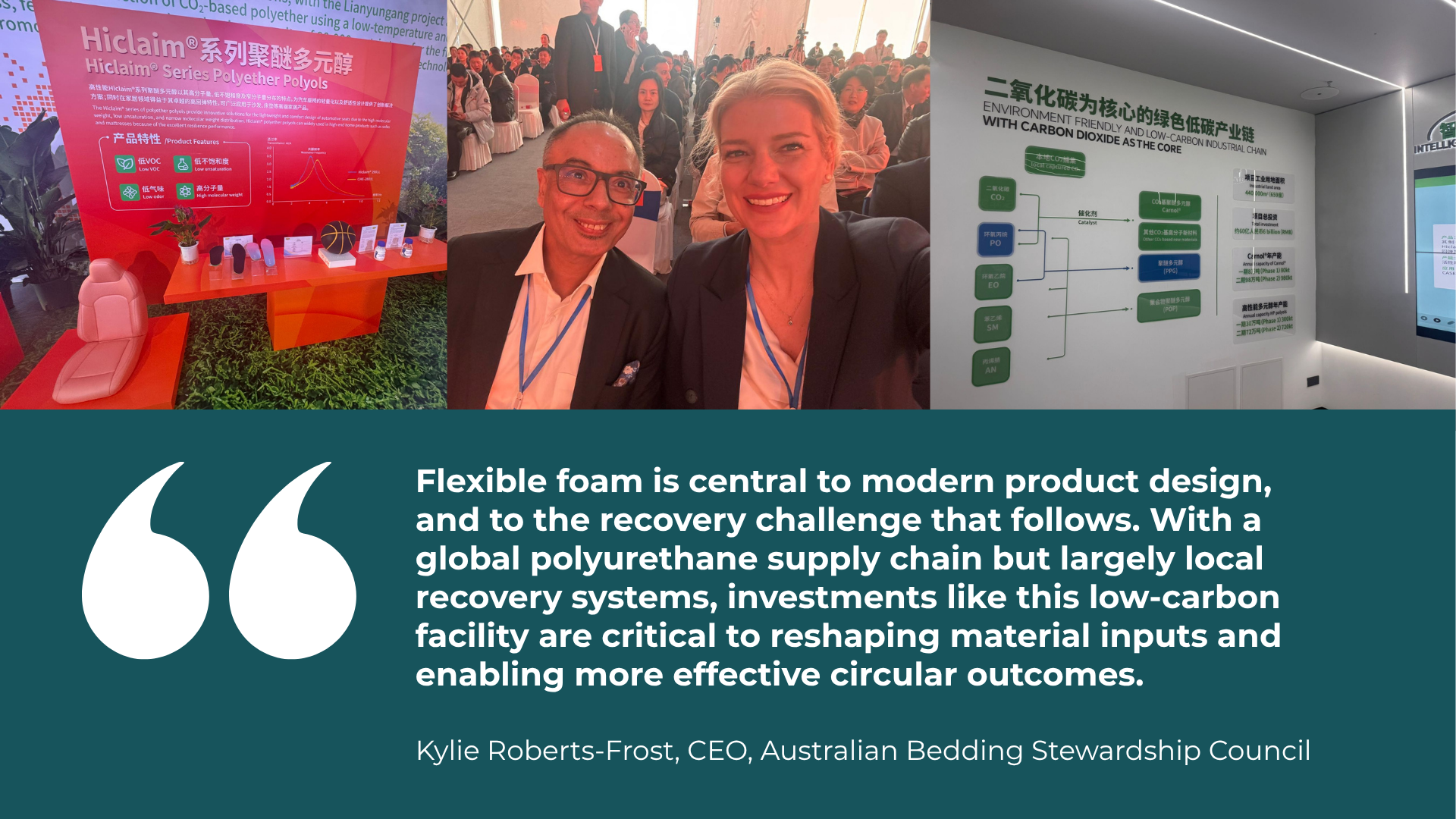
That is why forums like the 2026 Global Polyurethane Sustainability & CO₂ Innovation Summit matter. Our CEO, Kylie Roberts-Frost, was honoured to be invited to join the opening of this ground-breaking facility, sharing the importance of collaboration across the value chain and the systems thinking required for true circularity. This event was jointly hosted by PUdaily and Shanghai Climate Week, and supported by the Lianyungang Municipal People’s Government, Changhua Chemical Technology Co., Ltd., the China Petroleum and Chemical Industry Federation, and the China Polyurethane Industry Association.
The Summit brought together policymakers, scientists, chemical producers, brand owners, and downstream sectors to bridge the gap between policy, technology, and market application. The inauguration of the CO₂-based polyol facility in Lianyungang is a powerful signal of what is now possible upstream.
The next challenge is downstream.
How do we ensure that the polyurethane products made with lower carbon inputs today can be recovered, reused, and reintegrated tomorrow?
From Design to Recovery
Circularity begins with material but proven after use.
For products built on flexible polyurethane foam, solving circularity means designing not just for performance and carbon reduction, but also for recovery logistics and end markets.
Progress is being made. Recovery volumes are growing. New partnerships are forming. End-use applications for recovered foam are emerging.
The gap we need to close is aligning production, recovery systems, and markets across regions.
This is the conversation we need to keep having. Engagement between material innovators, bedding manufacturers, and recovery system operators has never been more important.
Read more about the low carbon facility in PUDaily’s Press Release from the 2026 Global Polyurethane Sustainability and CO₂ Innovation Summit: https://www.pudaily.com/Home/NewsDetails/63580
Disclosure: Kylie’s attendance at the Global Polyurethane Sustainability & CO₂ Innovation Summit was supported by PUDaily, who sponsored her participation. No ABSC member funds were used for the overseas travel for this event.
Related Articles
30/06/2026
The Australian Bedding Stewardship Council announced in February that we have formalised...
18/05/2026
At the Australian Bedding Stewardship Council (ABSC), our mission is clear: to drive...

20/11/2025
The NSW Government’s new Waste and Circular Infrastructure Plan lays out a stark...