
Transforming Waste: Turning End-of-Life Mattresses into High-Performance Insulation
At the Australian Bedding Stewardship Council (ABSC), our mission is clear: to drive circularity within the bedding industry and keep mattresses out of landfill. While we have made great strides in recycling steel springs, the “soft parts” of a mattress – the foam and textiles – have historically been much harder to recover. Approximately 56% of mattresses collected for recycling are mechanically shredded, resulting in a complex mix of materials known as “floc” that currently lacks an off-take market.
In partnership with Swinburne University of Technology, we are pleased to share a breakthrough. Together, we are pioneering a way to transform this challenging waste stream into a valuable, sustainable building material.
The Science: Nature’s Own Recycler
The research is being conducted by Dr The Hong Phong (Peter) Nguyen under the supervision of project leader Associate Professor Mostafa Nikzad, with support from a multidisciplinary team. Members of the team are named inventors on a provisional patent (Australian application number 2025904163) covering mattress polyurethane (PU) and textile valorisation using fungal systems and lignocellulosic additives. These intellectual property assets reflect the novelty of the approach and provide a strong foundation for future commercialisation and industry partnerships. Dr Huseyin Sumer contributes biological expertise, Dr Lachlan Thompson provides chemical insights, and Dr Fareed Tamaddoni Jahromi supports the mechanical shredding processes. Product validation is carried out with the support of Dr Md Morshed Alam, while commercial guidance is provided by our Director of Innovation, Tracey Pryor.
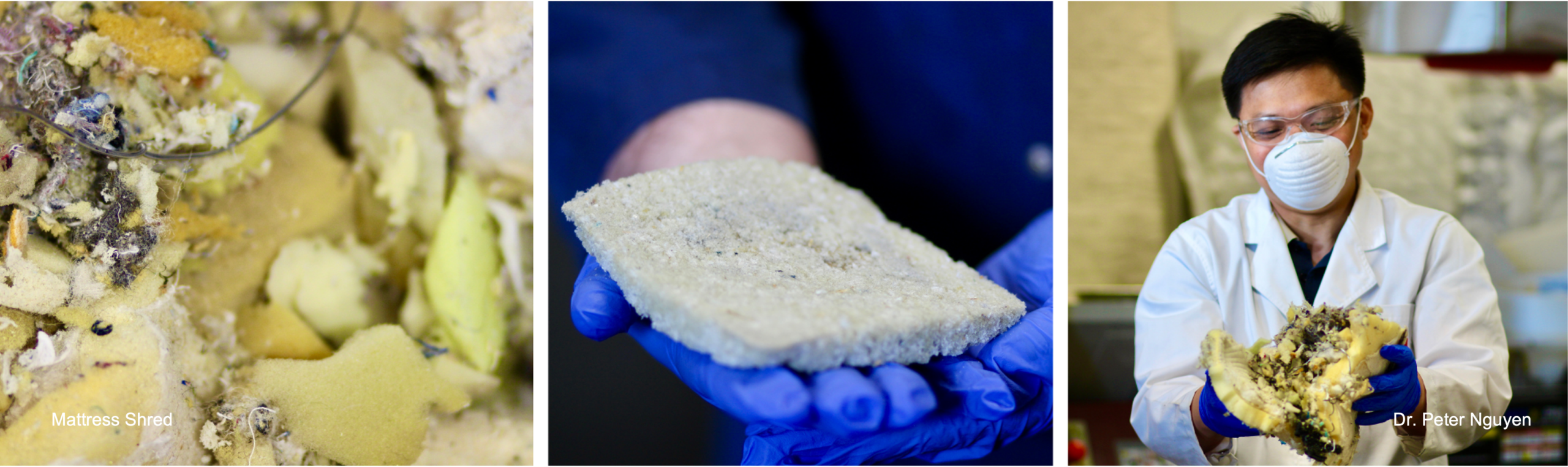
The project explores a natural way to turn mattress shred into a useful insulation material. Using a fungus called Penicillium chrysogenum, the research team has developed a process that helps bind together shredded mattress foam and textiles into a lightweight material. Early results show that the material has promising insulation performance and remains highly stable when exposed to very high temperatures.
Why This Matters for Circularity
This innovation has the potential to address one of the key material challenges in mattress resource recovery:
Diverting Waste: Over 1.8 million mattresses are discarded in Australia every year. This approach could help give some of those materials a valuable second life.
Heat Resistance: Early testing indicates that the material remains highly stable at temperatures approaching 1000°C, supporting its potential for insulation applications, especially where strong thermal stability is important.
More Sustainable Materials: By using recovered mattress materials and a biologically based process, this work supports the development of lower-impact alternatives for the built environment.
The Funding Challenge: Looking Beyond Our Borders
To transition this breakthrough from the lab to the marketplace, the research team at Swinburne University of Technology, with guidance from the ABSC, is actively pursuing international funding.
While we had previously looked to local support, we recently learned that the Australian Government’s Economic Accelerator (AEA) grant program has been closed to further awards. The loss of this local funding stream highlights a critical risk: without domestic investment, world-leading Australian innovations may be implemented and commercialised overseas first.
To ensure this research continues to progress, Swinburne University of Technology will apply for a grant in partnership with ABSC industry partner Mattress Recycling Council (MRC) in the United States. We are proud to provide a formal letter of support for this application as part of efforts to help bridge the gap in mattress shred off-take markets.
This funding is essential for the next phase of development:
Refining the Process: Optimising fungal bioconversion to handle the high variability of real-world polyurethane foam and textile waste.
Scaling Up: Moving from 50g laboratory batches to pilot-scale production in coordination with our industry partners, Repurpose Recycling and Four Seasons Industries.
Attracting Investment: Lifting the Technology Readiness Level (TRL) to attract investment from industry to further develop the commercialisation of the product.
Advancing the Circular Economy for Bedding
This project remains a cornerstone of our commitment to creating a truly circular economy for bedding. While we must now look internationally for support, our aim remains to ensure the Australian bedding industry stays at the forefront of global sustainability.
Success here could be game-changing, with potential applications for other difficult waste streams such as carpets and mixed clothing textiles. As Dr Peter Nguyen of Swinburne University of Technology notes, “Our work shows how science and industry can come together to turn difficult waste into something useful, safe and sustainable.”
We look forward to keeping our members updated as we navigate these global funding pathways and work towards a future in which no part of a mattress is treated as waste.
Read the full article published in Nature by Swinburne: https://www.nature.com/articles/s41598-025-30954-x
Related Articles

31/03/2026
The global conversation on polyurethane is changing quickly. Across Asia, Europe...

20/11/2025
The NSW Government’s new Waste and Circular Infrastructure Plan lays out a stark...

31/10/2024
At the Australian Bedding Stewardship Council (ABSC), we believe in driving change...